



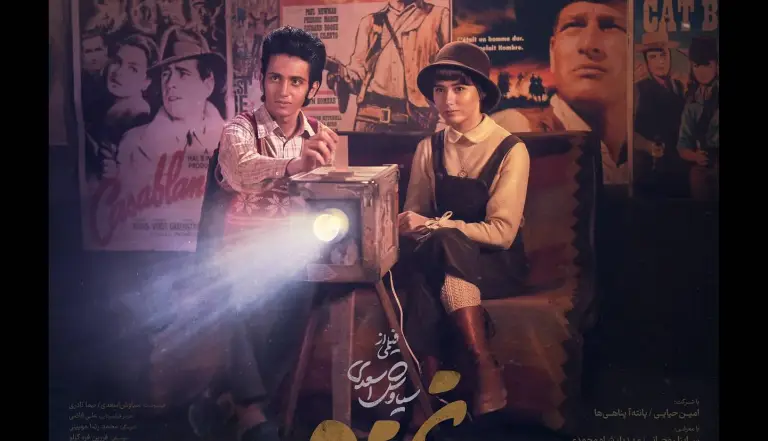
From the very first moments, Siavash Asadi’s film Instinct seems to establish its position within its own conventional world: it wants to draw the audience into a story that oscillates between harsh reality and charming fantasies, between secrecy and emotion. The film aims simultaneously to tell a passionate teenage love story, bear the weight of a family tragedy, and open a window onto history. Yet, exactly at the point where it should decide how to carry out and conclude what it wants to be, it stalls, getting lost in a narrative triangle—“what,” “why,” and “how.”
Cinema has long moved past merely asking, “What happens?” The main plot is no longer the core concern; rather, it is the “why” and “how” of an event that truly matter. This is the familiar principle of contemporary storytelling: no matter what, it matters why and how.
In *Instinct*, however, the problem lies precisely here. The audience encounters a narrative that seems to handle the “what” well: a girl, a boy, love, a secret, betrayal, and an ending intended to surprise. Yet, the “why” and “how” of these events show serious gaps. Instead of planting the seeds of meaning, the film merely arranges images; and while these arrangements are occasionally beautiful, they remain empty.
Amin Hayayi plays a man caught between past and present, debt and conscience. On the surface, his motivation seems clear: he owes his friend. But is this debt and its magnitude sufficiently established in the film? Does the audience grasp the depth of their shared past, or are viewers expected to accept through a few brief, shallow dialogues that such a profound emotional and moral bond existed—one that now justifies sacrificing a beloved, a daughter, and, most importantly, a son? Here, the narrative falters. When the “why” is devoid of internal logic, the “what” also loses meaning.
The first half of the film, and even beyond that, follows a teenage love story that could be a strength of the work. The passion depicted recalls the intensity of first love at an age when reason has not yet dominated emotion. Yet even this section abruptly cuts off at the ending. The love that began with a lively rhythm and warm, vivid images suddenly ends in a brief scene, reduced to a minimal reaction, such as retrieving a lighter and setting on fire the car where their first meeting occurred. How can two teenagers, immersed in a world of emotions moments before, suddenly abandon everything with such adult composure? This transition lacks any narrative logic.
The lack of depth continues in character development. The daughter of the family and the late friend’s wife, played by Pantea Panahiha, appear less as characters and more as narrative tools. Their presence primarily fills gaps in the story rather than offering meaningful, concept-rich roles. Panahiha’s character exists only to enable the film’s final surprise, and the daughter merely ensures the story does not remain empty. Consequently, the author’s hand is conspicuous and artificial; characters seem planted from outside rather than organically growing from the story.
In terms of mise-en-scène and imagery, Instinct oscillates between form and content. Asadi knows how to compose a beautiful frame, but pure beauty without internal motivation ultimately becomes mere decoration. Long shots of rural roads, warm lighting, and nostalgic set design serve more as background than as tools to deepen the narrative world. Even at its most visually striking, the film struggles to convey meaning because its “why” remains empty.
Instinct attempts to speak poetically about love and destiny but falls prey to the very determinism it initially set up. The narrative, at its ending, gets lost in superficial complexity rather than depth. The filmmaker seems so enamored with the idea of a surprise that he forgets to provide the necessary background for it.
Finally, a blunt question arises: how long will Iranian filmmakers continue to retreat into historical periods to avoid censorship and bans? How long will narratives be detached from the present, twisting meaning in Qajar, Pahlavi, or timeless eras? When a film like Instinct, despite all its historical staging, is still banned for years, why should we accept this artificial retreat? Instead of spending energy and resources on costumes, sets, arches, and mansions, why not invest in creating a world that takes place in the present, in today’s city and era? If a film is to be banned, let it be for its boldness. If a film is about love, let passion flow within it, not be sacrificed for a superficial, unsubstantiated surprise ending.