



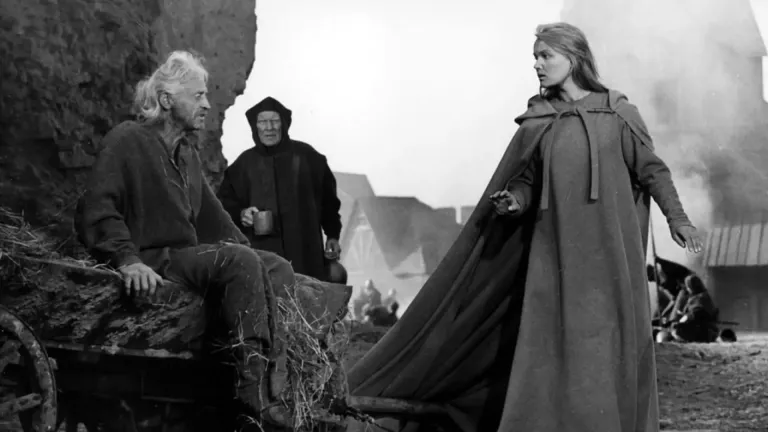
The Russian film King Lear is an adaptation of one of the greatest works in world literature—an adaptation that stands out among the many cinematic renditions of Shakespeare’s tragedy thanks to its auteur-driven vision and its distinct visual language. It is a film that portrays the gradual downfall of an aging, forsaken king through imagery that is both poetic and fiercely expressive.
Grigori Mikhailovich Kozintsev, the Russian screenwriter and auteur who lived and created his art during the Soviet era, had a particular devotion to the art of adaptation. It was through his works based on enduring literary masterpieces that he secured a unique place in world cinema.
His adaptations of Shakespeare—Hamlet (1964) and King Lear (1970)—as well as Cervantes’s Don Quixote (1957), are among the most significant works of his late career and earned him international recognition. These films brought him numerous nominations at major festivals such as Cannes, Chicago, and Venice, along with BAFTA and other awards. The Special Jury Prize at the Venice Film Festival for his adaptation of Hamlet stands as a testament to his mastery of the form.
In 1970, according to IMDb, Kozintsev directed the final film of his career, drawing once again on a classical work. William Shakespeare, the father of English drama, likely wrote King Lear around 1605, crafting a tragedy that chronicles the collapse of an elderly king—both psychologically and socially.
From past to present, and undoubtedly into the future, this play has inspired countless adaptations on stage and screen. Among the most distinguished cinematic interpretations outside the English-speaking world are Kozintsev’s King Lear and Akira Kurosawa’s Ran (1985).
Shakespeare’s five-act play, built on two parallel storylines, is often regarded as one of the greatest achievements in dramatic art. In 1949, as listed by IMDb, the celebrated writer and poet Boris Pasternak translated the play into Russian; it was this translation that served as Kozintsev’s primary source.
Kozintsev wrote the screenplay himself. The 140-minute film features music by Dmitri Shostakovich and stars Yuri Yarvet as King Lear. To this day, it remains one of the outstanding works of classical cinema.
Kozintsev’s faithful adaptation follows Shakespeare’s story through the turbulent final chapter in the life of an aging monarch. Lear, played by Yarvet, decides to divide his kingdom among his three daughters—Goneril (Elza Radzina), Regan (Galina Volchek), and Cordelia (Valentina Shendrikova)—and bases their inheritance on the fervor with which they proclaim their love for him.
Within this dramatic structure, characters and their relationships unfold in ways that reflect their inherent or deliberately performed human qualities. Throughout the film, the audience witnesses the erosion of morality under the weight of ambition and self-interest, yet slowly gains a deeper understanding of how each character navigates their own selfhood, their society, and the stormy arc of the narrative.
The film depicts the imbalance between love and power in such a way that the slow, corrosive influence of greed and personal gain becomes palpable within a grand, meticulously crafted atmosphere. Alongside Lear, the viewer experiences the fall—a hollowing out, a descent into ruin.
Cordelia, unwilling to flatter her father for personal advantage, is cast aside by the proud king and stripped of her rightful inheritance. In contrast, Goneril and Regan orchestrate grand displays of affection to deceive and manipulate him. These characters are strikingly recognizable across eras and borders—just as Lear himself is, with his tragic weaknesses that undermine his age, experience, and royal authority.
It is precisely these fatal flaws that compel the vain, obstinate king to banish his youngest daughter despite having once cherished her. This act becomes the spark that ignites his downfall—a descent that will be echoed in the treachery of his elder daughters, eventually leading him back to the very origin of his undoing. He becomes the architect of his own collapse.
Kozintsev traces Lear’s disintegration—both inner and societal—through layered monologues and psychologically rich dialogue. This journey brings Lear to an astonishing confrontation with himself and, on a broader scale, with his land and kingdom, both of which he has lost in a deceitful, one-sided bargain.
In a society where wealth, inheritance, and power determine social standing and shape one’s future, Lear’s decisions reverberate far beyond his family, threatening the destiny of an entire nation.
Thus the intimate dynamics of a single family expand into matters of national significance, culminating in Lear’s internal and external collapse—his madness, his despair.
A king who once stood at the height of authority suddenly finds himself cast into an abyss of emotional, familial, social, and political rejection—forced at last to face the enormity of his error, an error as immense as the warm, gentle embrace of the daughter he drove away.
The film vividly evokes the remnants of a feudal system, contrasting impoverished wanderers and the homeless against ruins, hovels, and landscapes battered by wind, rain, and shifting shadows. These images create an atmosphere steeped in misery and hardship, allowing the film’s themes to resonate even more deeply.
In the end, King Lear becomes a mirror held up to fundamental moral dualities: wisdom and folly, humility and pride, sincerity and deception, love and selfishness—values that lie at the core of human relationships. Within the film’s layered drama, these themes are placed on trial, serving as a timeless warning to humanity not to repeat Lear’s tragic fate, blinded by an awakening that comes far too late.