



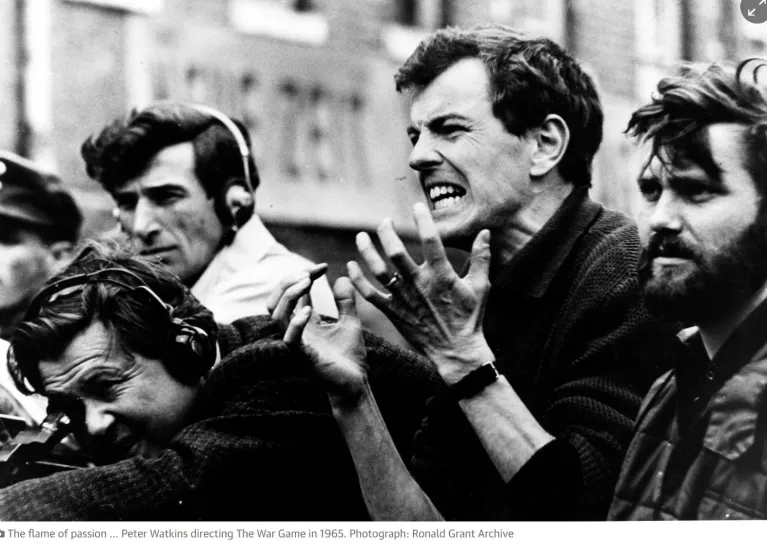
Peter Watkins, the left-wing filmmaker and one of the most unconventional British directors, has died at the age of ninety. Many regard him as a pioneer of the docudrama genre—a form built on dramatizing and reconstructing historical events in the style of documentary filmmaking—and also of the mockumentary, a “fabricated documentary” that uses the documentary form to portray fictional events and characters. These personal, free-form cinematic styles aligned closely with Watkins’ radical political vision. He found conventional television documentary formats unsuitable for expressing his ideas, and thus developed a unique method of historical nonfiction filmmaking, completely unlike the standard historical series and documentaries produced by the BBC or other broadcasters. Above all, his films testify to the expressive limits and narrow capacities of traditional television documentary practices. Watkins not only chose subjects rarely represented in Western media, but in works such as The War Game and The Gladiators he adopted an entirely radical stance against Western media institutions and openly criticized their methods.
Watkins believed that the media are generally dominated by groups who maintain their economic and political power over both the public and filmmakers by employing specific strategies. According to him, these strategies include: earning public trust through seemingly entertaining programs that legitimize managerial control over content; presenting certain narrative forms as the only valid model of production; maintaining hierarchical relations between mainstream media and the public; using speed, fragmentation, and shortened content to prevent audience concentration and critical analysis; promoting the illusion of neutrality and objectivity; restricting the public’s access to understanding how media systems function; collaborating with universities to create standardized professional training; and ultimately suppressing and marginalizing dissenting voices. (Watkins, 2015: 6)
Watkins paid a heavy price—professionally and personally—for his leftist political commitments and his nonconformist cinematic approach. As a filmmaker who broke away from mainstream cinema and its dominant narratives, he was pushed to the margins. His films were repeatedly censored or banned. In his writings and critiques of media and Hollywood, he harshly attacked the dominance of the Hollywood narrative style, which he termed “the Monoform” (Watkins, 2015: 21). Although his docudramas share some features with cinéma vérité—such as handheld camerawork, improvisation, and interviews—Watkins’ cinema differs fundamentally from vérité because it involves staged reconstructions, fictionalized events and characters, and the use of non-actors and amateur performers in quasi-documentary settings.
In Watkins’ work, time is dynamic and flexible, reflecting his deep interest in history and the unfolding of events. His films establish an interactive relationship with time. Reviewing his early films shows how creatively he dissolves temporal boundaries. His career begins with portrayals of the past—as in The Web and The Diary of an Unknown Soldier. In The Forgotten Faces, he brings the past into the present; in Culloden, he anchors the present in the past; and in The War Game, he fuses the present with an imminent future. Watkins thus demonstrates that historical events are always capable of recurrence, and that understanding the past is a way of understanding the present. Importantly, he conveys this idea not through slogans or moralizing messages, but through narrative form—experimentally, and within the structure of his films.
Watkins consistently steps away from conventional narrative structures, seeking instead to create a dialogic, interactive space between film and viewer—one in which shared understanding becomes possible. He insists on the “filmic” nature of film and sees the boundaries of time and place as fluid. He invites ordinary people to participate in the filmmaking process and abandons traditional hierarchical forms of production. In articulating his political and social views, he is transparent and honest; his purpose is public education and social awareness, especially in the context of anticipating and understanding crises before they occur. His films warn, explain, and confront fundamental political and social issues. The imagination in Watkins’ cinema is not the fantasy imagination of Hollywood, intended for entertainment or stupefaction, but rather a constructive and dynamic imagination—one that challenges existing reality and helps the viewer understand both the real world and the mechanisms through which capitalism distorts it. His approach to history and historical figures is both Marxist and deeply personal, and he interprets them through a realist style entirely his own. In his historical reconstructions, Watkins treats historical subjects as living, contemporary realities. Through dramatization—and through defamiliarization—he presents subversive new images of well-known events and figures. Unsurprisingly, his films often diverge sharply from official historical narratives, which has led to both official and unofficial opposition. His works have therefore been distributed and screened only in severely limited forms.
The narrator in Watkins’ documentaries is an active, conscious figure—a mediator between filmmaker and audience. Through this narrator, Watkins communicates his feelings, ideas, and personal perspectives directly and candidly. This type of narrator appears in nearly all his works. For instance, in The Diary of an Unknown Soldier, Watkins breaks the conventional narrative structure and merges it with newsreel documentary techniques. The film is a blend of narrative and diverse artistic and cinematic styles: the soldier’s poetic, unconventional narration of war and death is interwoven with expressionistic imagery and a documentary sensibility. The Forgotten Faces marks a turning point in his career. As Watkins’ first historical docudrama, it reconstructs a revolution in a documentary style, yet outside its actual time and place. Watkins himself called this method “reconstructed realism.” Through combining elements of drama and documentary, he achieved a personal cinematic language—a new form that launched a creative phase in his work in which power, imagination, and reality collide.
Watkins’ subsequent film, Culloden, made for the BBC, depicts the 1745 battle between Scottish Jacobite rebels and the British crown. He employed the techniques of Vietnam War newsreels, bringing a startling freshness to the reconstruction of this historical event. His camera behaves like that of contemporary TV reporters, moving directly into the battlefield as the narrator interviews commanders such as the Duke of Cumberland (leader of British forces) and Charles Edward Stuart (leader of the Jacobite uprising), as well as ordinary rebels. Watkins later used the same method in films such as La Commune (Paris 1871) and Edvard Munch. The film is composed of long, uncut ten-minute takes. Wide-angle lenses shift attention away from individual heroes and toward the collective presence of the people. The mise-en-scène follows the movement of crowds, and the camera sometimes changes direction simply because actors do so. From the outset, the film is self-aware and metacinematic: showing the film crew, introducing actors as actors, and featuring reporters with microphones—all of this emphasizes the film’s reflexivity. Characters look directly into the camera rather than ignoring it, and this awareness is transferred to the audience. Information such as the time and location of filming, shot lengths, and post-production additions become part of the film’s educational critique of media’s role in both past and present.
Watkins made La Commune (Paris 1871) in just thirteen days, shooting inside an abandoned factory on the outskirts of Paris. The film recounts the revolutionary uprising of French workers in the spring of 1871—one of the most important events in the history of the European labor and communist movements. To make the film’s political divisions more believable, Watkins placed newspaper ads inviting people with anti-communist views to play anti-communist roles. Two hundred non-professional actors reenacted the uprising on a set resembling a theatre stage. But Watkins did not limit himself to reconstruction; he removed the event from its historical setting and brought it into the present, presenting it through two contradictory perspectives: that of the French state television and that of the Commune’s own television. According to Watkins, the Paris Commune has long occupied a marginal place in France’s educational system, despite being a crucial moment in the history of the European working class. Many cast members, he noted, had never heard a single word about it.
Arte Television and the Musée d’Orsay co-produced the film. Yet, contrary to Watkins’ expectations, Arte behaved much like mainstream media. After filming ended, Arte’s management demanded significant cuts and major revisions to the edit—demands Watkins steadfastly refused. In response, Arte unilaterally decided not to broadcast the film at the scheduled time. The damage did not stop there: the original negative was eventually lost, and the network violated its contract to release a video edition of the film. Ultimately, Arte prevented any public screening of the work.
Opposition to war and the militaristic policies of governments is one of the central themes of Watkins’s docudramas. The success of Culloden and the positive response it received from BBC audiences led the network to commission another documentary from Watkins—this time on nuclear war. In The War Game, Watkins examines how the media are administered and controlled, while also exploring the potential consequences of a nuclear conflict in Britain. Watkins says of The War Game:
“In the 1960s, British television avoided discussing the arms race and remained silent about the effects of nuclear weapons—something the majority of people knew almost nothing about. For this reason, I suggested to the BBC that if we were to treat a small part of Kent in southeastern England as a microcosm of Britain, I would depict the outbreak of nuclear war between NATO and the Soviet Union following a Soviet atomic attack on the UK.”
In The War Game, Watkins deliberately avoids explicit and graphic depictions of violence. Instead of relying on shocking images, he uses the voice-over narrator to convey aspects of nuclear catastrophe that cannot be shown visually. Through this method, he brings the imagined horrors of a nuclear war into a palpable and tangible realm. In doing so, he relocates a catastrophe that is often imagined by Western viewers as something distant—something happening to an Eastern “other”—into the cultural space of the West itself, rendering it a universal disaster. For instance, by recounting the fate of a young boy who, after being exposed to nuclear radiation in the bombing of Hiroshima, was hospitalized for seven years before dying, Watkins transforms Hiroshima from a remote historical event into a human, recognizable experience for Western audiences. Thus he dissolves the boundary between “self” and “other,” compelling viewers to confront the disaster not as someone else’s tragedy but as a global crisis that concerns them directly.
Although The War Game won the Special Prize at the 1966 Venice Film Festival, the 1966 Academy Award for Best Documentary Feature, and the British Academy Award for Best Documentary, the film did not satisfy BBC executives and was denied television broadcast. It remained banned for twenty years before finally being shown in 1985. John Lennon, in a 1969 interview, spoke of the influence that Watkins and The War Game had on his peace activism. He said that Watkins had written to him:
“People in your position have a responsibility to use the media for world peace.”
Lennon added that after receiving this letter, he spent three weeks thinking about it.
After the BBC banned The War Game, Watkins made the allegorical fiction film Privilege (1967), about a popular and widely adored singer named Steven Shorter whose every action is controlled by church and state in a totalitarian society. Privilege, made during the “Swinging London” era and starring pop star Paul Jones and sixties supermodel Jean Shrimpton, is a darkly humorous film in the style of Kubrick’s A Clockwork Orange, critiquing totalitarianism and youth rebellion. Steven Shorter, the film’s protagonist, becomes—after state and church–imposed brainwashing—a kind of spiritual leader for the nation. According to Watkins, the film was a prophetic portrayal of how American mass media and popular culture would later commercialize the anti-war and countercultural movements. Watkins also claimed that the film anticipated political developments in Britain under Margaret Thatcher in the 1980s, especially the Falklands War. He later asserted that Stanley Kubrick had drawn inspiration from Privilege when making A Clockwork Orange and that certain scenes in Kubrick’s film were based on his own.
Following the banning of The War Game and the commercial failure of Privilege, Watkins left the UK and made the remainder of his films abroad—in Sweden, Norway, France, and the United States. After settling in Sweden, he made The Gladiators (1969), a dark satire on the nuclear powers of the modern world. Styled like a science-fiction film and set in the near future, it depicts a world in which the great powers of East and West, in order to prevent a third world war, stage a global television spectacle known as the “International Peace Game,” forcing teenage soldiers to fight one another to the death like gladiators while the event is broadcast live around the world.
Watkins’s reputation as a radical political filmmaker became firmly established with Punishment Park (1970). Made at the height of the Vietnam War, the film examines the violence of the U.S. military against political dissidents and the mass killing of protestors. In the midst of a large anti-war demonstration, a group of protesters and political dissidents, arrested on charges of “threatening national security,” are given a choice between long prison sentences and participating in a deadly three-day punitive operation. They must cross 53 miles of scorching desert—without food—under 110-degree heat to reach an American flag planted atop a distant hill. Failure means a lifetime in federal prison. Watkins frames the narrative through a group of European documentary filmmakers who are present to “record” the operation. As in Culloden and Edvard Munch, the roles of American soldiers and dissidents are played by individuals who genuinely identify with the positions they portray.
Shot in 16mm with a crew of eight and a single Éclair camera, Punishment Park adopts a cinéma-vérité style. Although Watkins had a detailed script, he allowed actors to improvise freely according to their emotions and understanding of the situation. The film stands as an anti-fascist indictment of the U.S. government, with explicit references to contemporary political events such as the Vietnam War. Its screening at the 1971 New York Film Festival generated intense controversy; many critics rejected its unconventional form, while conservative commentators denounced it as communist and anti-American. Hollywood studios refused to distribute it.
Watkins’s next film, Evening Land (1976), recounts two interrelated media events from the 1970s: a shipbuilders’ strike in Copenhagen and the kidnapping of a Danish government official by a guerrilla group during a European Economic Community summit. Featuring 192 non-professional actors, the film uses dialectical editing to explore the crisis of European capitalism, the model of Danish social democracy, state repression, police violence against political dissidents, unemployment, and economic stagnation. Evening Land won the Golden Prize at the 1977 Moscow International Film Festival.
Watkins also made several unique films about prominent European artists. His 210-minute Edvard Munch (1975) is an extraordinary study of the private and professional life of the Norwegian painter. Ingmar Bergman called the film a work of genius. It is among the most experimental documentaries ever made about a major modernist artist. Drawing on Munch’s unpublished diaries, Watkins attempts to enter the painter’s inner world, revealing his fears, regrets, and emotional restraints. Originally produced for Swedish and Norwegian television, the film covers thirty years of Munch’s life and explores the impact of illness and death within his family on his art. As in televised news reports, the characters speak directly into the camera. Using non-professional Norwegian actors and improvisation, Watkins depicts the life of an artist who struggled amidst hostility, misunderstanding, and inner torment. As in La Commune (Paris, 1871), he cast Norwegian actors who disliked Munch’s work to play the painter’s critics.
Edvard Munch opens with a party attended by well-known artistic figures of the time, such as August Strindberg and Christian Krohg. The realistic atmosphere, handheld camerawork, and Watkins’s narration create the feeling of watching documentary footage. The camera introduces each guest before turning to Munch, whose introverted and alienated character is presented from the outset. Watkins said:
“Edvard Munch is the most personal film I have made. The idea arose when several of my films were screened in 1968 at the University of Oslo’s Munch Museum. I was deeply struck by the power of Munch’s canvases, especially those relating to his tragic family history. The frankness of this artist, and of the people he depicted—staring directly at us—affected me profoundly….”
The film won the 1977 BAFTA Award for Best Foreign Television Program and screened again in 2012 at Tate Modern alongside the major retrospective Edvard Munch: The Modern Eye.
Watkins followed with The Freethinker (1992–94), another biographical reconstruction, this time about August Strindberg. Made in the same spirit as Edvard Munch, it uses his distinctive style of historical reenactment and was created with the participation of students from a Swedish drama school.
His last major docudrama to date is the fourteen-hour The Journey (Resan, 1983–85), filmed across several continents. Its subjects are nuclear weapons, military spending, and global poverty, explored through interviews with ordinary people from various countries who express sharply divergent views. The film has had only a few screenings, including at the Toronto and Mexico City film festivals and at the Austrian Film Museum as part of a Watkins retrospective.
Peter Watkins is also the author of Media Crisis, a book discussing new media forms. In September 2012, Tate Modern in London organized a retrospective honoring Watkins, screening all of his films.