



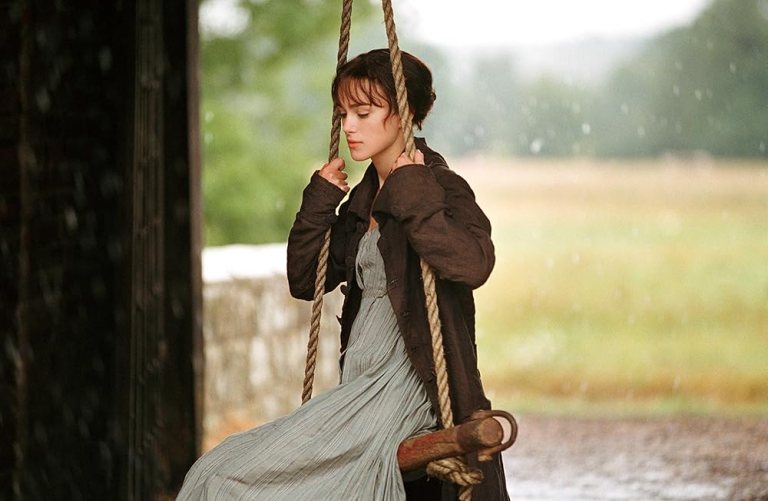
The film Pride & Prejudice revolves around a classic adaptation drama that explores the contrasting temperaments of people in challenging romantic relationships, while also examining the precarious social position of women in 17th-18th century England.
Joe Wright, an English director, is known for films such as Atonement, Hanna, Anna Karenina, Pan, and Darkest Hour. His adaptive approach is clearly traceable across his works, and his screenplays are typically written by professional screenwriters.
In 2005, Wright decided to create a faithful adaptation of Jane Austen’s classic novel Pride & Prejudice, which has been adapted into numerous films and series over the years. One earlier version, from 1940, was directed by Robert Z. Leonard and starred Laurence Olivier as Mr. Darcy, representing only one of these adaptations.
Jane Austen, the English novelist of the 18th–19th centuries, had a particular skill and focus on portraying women’s characters and social positions, shaped by her era. Pride & Prejudice is her second novel, written in 1796 at the age of 21. Originally titled First Impressions, it faced a long path to publication, finally being released 17 years later, in 1813.
The screenplay for Wright’s 2005 adaptation was co-written by Deborah Moggach and Emma Thompson, the prominent English actress. Thompson had previously adapted Austen’s first novel, Sense and Sensibility, in 1995, also playing Elinor Dashwood, which earned her an Academy Award for Best Adapted Screenplay.
The film was nominated for four Academy Awards: Best Actress (Keira Knightley), Art Direction, Costume Design, and Original Score. It also received six BAFTA nominations, winning the Carl Foreman Award for the Best Newcomer Director. Numerous other festival nominations and awards recognized its cinematic achievements.
Set in England in 1797, the film centers on the Bennet family, which lacks social status and wealth, and faces the challenge of securing futures for its five young daughters. This situation drives the mother to actively seek suitable marriages for them with wealthy suitors, often at the expense of the daughters’ and family’s dignity.
Society, as depicted in the film, views marriage to wealthy gentlemen as the primary path to happiness for daughters, and communal balls serve as arenas for “hunting” suitable husbands—a societal ritual that frames the narrative.
Within this context, the Bennet family functions as a symbolic microcosm, where each daughter, with a distinct temperament, approaches marriage differently, setting the stage for conflict.
Elizabeth Bennet (Keira Knightley), the second eldest daughter, emerges as an outspoken and independent observer of society’s critical gaze toward her family. She is firm, serious, and refuses to accept marriage as a mere social obligation. Her understanding of love, marriage, and the ideal partner is active and contrasts sharply with the more passive approach of her sisters.
The filmmaker skillfully links Knightley’s youthful beauty and subtlety with Elizabeth’s courage and seriousness, establishing early dramatic tension between her and the newly arrived gentleman, Mr. Darcy (Matthew Macfadyen), in the initial ball scene. Darcy declines Elizabeth’s dance invitation out of shyness and lack of skill, which she interprets as pride—introducing the film’s central themes of “pride and prejudice” as dramatic levers.
Elizabeth and Darcy’s evolving relationship—from initial disdain to eventual love—drives the narrative, alongside complementary characters such as Jane (Elizabeth’s sister, played by Rosamund Pike) and Bingley (Darcy’s friend, Simon Woods), whose romantic arcs mirror and amplify the main couple’s emotional journey.
Much of the drama in the story unfolds through the characters’ inner thoughts, misunderstandings, and personal conflicts. While Austen conveys this through words in the novel, the film translates these subtleties into visual storytelling.
A standout example occurs mid-film when Elizabeth confronts her reflection in a mirror, a scene that conveys both the passage of time and a sense of timeless, placeless introspection. Darcy’s letter enters this visual narrative, serving as a step toward resolving Elizabeth’s misconceptions about him.
Throughout the two-hour film, which condenses key moments of the novel while expanding supporting characters and subplots in harmony with the main story, the filmmakers incorporate controlled humor to maintain balance, resulting in a polished and engaging cinematic experience.
Ultimately, this adaptation presents a classic romantic story that remains faithful to the novel’s trajectory while offering a fresh visual and cinematic perspective. It engages viewers, including readers of Austen’s original work, with its expressive imagery, nuanced performances, and elegant tone.