



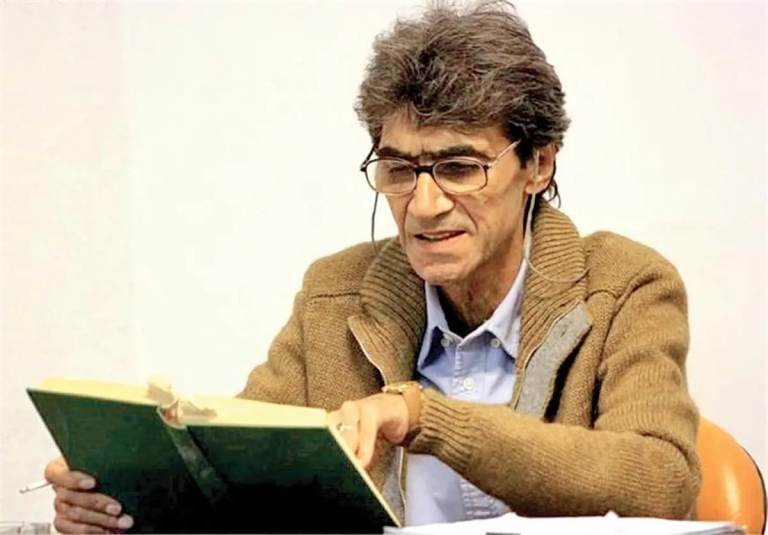
Final Scene: The White Splendor of a Filmmaker Who Was and Remained Independent | A Look at the Element of “Independence” in Nasser Taghvai’s Character and Works
It was late in the year 2022 when news broke that Nasser Taghvai’s works had been removed from platforms such as Filimo, Namava, and FilmNet—works like The Sun Chief and Paper without Lines. I remember writing an article at the time titled “The Punishment of a Filmmaker Who Remained Independent”, which was published on BBC Persian. Now, as Nasser Taghvai has passed away after more than two decades of silence and inactivity, I return to that sentence. A artist who was independent and refused to give up his independence—for recognition, for income, or even for creation itself.
Nasser Taghvai was independent from the very start of his artistic career. In 1969, he published the short story collection That Summer, consisting of eight interrelated stories. Looking at the publisher, we see that it was Taghvai himself. Set in the working-class milieu of the 1950s, this collection shows that even in his youth, he refused to have his stories published under the name of a prominent publisher or to be subject to censorship. Although the book was only printed once and never reissued, Taghvai had already been drawn—willingly or unwillingly—toward cinema. He began his career in film working with Ebrahim Golestan, who had sufficient personal resources to establish his own studio, buy cameras from Europe, and produce films independently of any institutional authority. Initially, Taghvai worked in the technical team on Golestan’s Brick and Mirror, a film often cited by critics as the first work of Iran’s new wave cinema.
In 1967, Taghvai joined the National Iranian Radio and Television Organization. Although this was a state institution, its managers were independent individuals without overt political bias. There, Taghvai was able to test his talent in documentary filmmaking, eventually becoming one of the most important documentarians in the history of Iranian cinema. In interviews, he noted that he was independent in choosing documentary subjects, only informing his superiors of the topic; they had no role in deciding the subject matter or how it was executed. With his unique perspective on rituals and social issues, Taghvai made documentaries on subjects few Iranian artists and filmmakers had explored at the time—rituals such as Zar on Hormuz Island, sword dancing in areas of Bandar Abbas, ceremonies in Minab, southern music, and religious ceremonies like Arba’een and the Qali Shuyan ritual in Mashhad Ardehal. Each of these documentaries stands as a significant historical record of Iranian customs and ceremonies from past to present.
Taghvai directed his first feature film in 1970, Tranquility in the Presence of Others, adapted from a story of the same name by Gholam-Hossein Saedi. The film tells the story of a retired colonel who comes from the provinces to Tehran. An alcoholic showing early signs of psychological breakdown, he struggles to cope with the modern lives of his two daughters, eventually ending up in a psychiatric hospital. The modern life around him ultimately claims the life of one of his daughters, played by Parto Nouri-Ala. In his past, he remains a powerful army colonel, yet now feels redundant. Notably, the film features Mohammad-Ali Sepanlou, the late contemporary poet, as a doctor named Sepanlou, and Manouchehr Atashi, another prominent poet, as a character named Atashi. Sepanlou plays a womanizing intellectual doctor, while Atashi portrays a man weary of modern life in Tehran. The colonel’s wife, Manijeh, played by the brilliant Soraya Ghasemi, rejects his love, and he too ends up in the hospital. The individuality and independent thinking of each character ultimately lead to their downfall. Taghvai’s first film faced censorship and was banned, only reaching public release four years later. With this debut, Taghvai demonstrated mastery of cinematic form and language, perfectly aligning form with content. This 83-minute film consistently ranks among the top ten in lists of Iran’s greatest films.
Before the revolution, he directed two more films—Sadegh Karde and The Curse—as well as the beloved series Uncle Napoleon for National Iranian Television under the management of Iraj Gorgin, producing it in sixteen episodes while largely maintaining his intellectual and artistic independence. However, with the 1979 Revolution, his independence was increasingly threatened by censorship, interference, and prohibition. Taghvai, who had made three films and one series in the eight years before the revolution, could produce only four feature films in the forty-six years after.
Among these post-revolution works, The Sun Chief (1986) is set in the southern landscapes and atmospheres familiar from his earlier works. The film garnered a flood of domestic and international awards, and many expected Taghvai to become one of Iran’s most prolific filmmakers. He also directed the 1989 film Ey Iran, an episode of the episodic film Kish Stories (1998) alongside two other directors, and the 2001 film Paper without Lines. Additionally, his series Mirza Kuchak Khan Jangali, based on his own screenplay (1985), was ultimately taken from him and completed by Behrooz Afkhami, a filmmaker aligned with the government.
In 2002–2003, Taghvai began two cinematic projects, Rumi and Zangi and Bitter Tea, about the war in Khuzestan. Both were abandoned due to lack of funding, subjects deemed anti-war by governmental film authorities, and refusal of cooperation by state institutions. At that point, he could no longer work independently. The all-encompassing censorship forced him to protest by refusing to make films. He turned to photography, teaching, and writing, though in the 2010s illness confined him to home. For 24 years, his silence voiced independence and a call for freedom, while many colleagues continued making films under the shadow of censorship and oppression. Long before, he had urged other filmmakers to stop producing films until a new, thoughtful cinema could emerge—perhaps only Bahram Beyzai shared this vision with him.
Although Nasser Taghvai established his name as a singular filmmaker in Iranian cinema with his completed works, it is his unmade films that cemented his immortality in contemporary Iranian history. Even in death, he confronted censorship, superstition, ignorance, and dogma. His final scene was the most magnificent scene of his life: a body resting in a wooden coffin, while his wife and admirers, dressed in white, cheered and played southern music to bid him farewell. There were no shrouds, no black clothes, no Quranic recitations, not a single religious Arabic word. No officials, no old colleagues now aligned with the government, not even a cleric. Nasser Taghvai went to his eternal home accompanied by the immortal verses of the Shahnameh, joining eternity itself.