



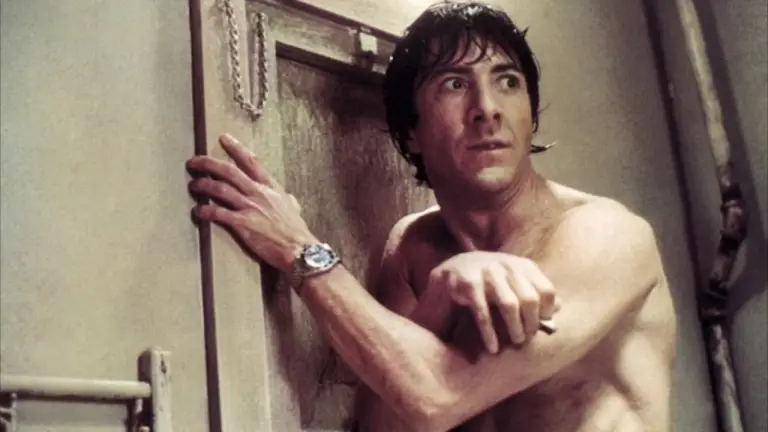
The film Marathon Man is a mystery–crime drama built around the trafficking of diamonds stolen from Auschwitz’s Jews by a Nazi. Decades later, the diamonds resurface as the pretext for dealings among smugglers—and mistakenly draw a marathon runner into a violent case. John Schlesinger, the English filmmaker, began his career with short films and documentaries before moving on to narrative features, winning numerous international awards. His documentary Terminus, focused on London’s Waterloo Station, won the Golden Lion at the Venice Film Festival, and his feature A Kind of Loving received the Golden Bear at Berlin.
Schlesinger achieved global recognition with the celebrated Midnight Cowboy (1969), starring Dustin Hoffman and Jon Voight, which earned him the Academy Award for Best Director. Other notable works include Billy Liar, Far from the Madding Crowd, and Sunday Bloody Sunday. In 1976, Schlesinger adapted William Goldman’s screenplay for Marathon Man, itself based on Goldman’s novel of the same name. Goldman, already a celebrated screenwriter, had won Oscars for Butch Cassidy and the Sundance Kid (1970, Best Original Screenplay) and All the President’s Men (1977, Best Adapted Screenplay).
Marathon Man earned Laurence Olivier an Academy Award nomination for Best Supporting Actor—the only supporting role among his many Oscar nominations—and he won the Golden Globe in that category. The film also garnered four additional Golden Globe nominations, two BAFTA nominations, and numerous other international accolades.
The story revolves around Thomas “Babe” Levy (Dustin Hoffman), a history student and long-distance runner in New York City. His introduction is subtle yet effective: in a university class, rather than answering the professor’s question aloud and earning praise, he stays silent, writing the answer only on his own paper—content simply with knowing what others do not.
This ingrained trait defines his character and sets the stage for the drama of his life, raising the golden “What if?”: What if a man who refuses to reveal what he knows—even at the risk of ridicule—were forced to disclose what he does not know, under threat of death… or at least the loss of a tooth?
The screenplay follows this trajectory. After the death of his brother Henry “Doc” Levy (Roy Scheider)—who, under the guise of an oil-company employee, secretly couriers the stolen diamonds—Babe becomes embroiled in the case. Unaware of the diamonds, of his brother’s hidden life, or of the fact that his girlfriend Elsa Opel (Marthe Keller) is a spy, Babe is thrust into a brutal conspiracy.
From this point, Babe’s direct confrontation with Dr. Christian Szell (Laurence Olivier)—a Nazi dentist seeking the Auschwitz diamonds—becomes a symbolic dramatization of this very condition:
Szell: Is it safe?
Babe: Are you talking to me?
Szell: Is it safe?
Babe: Safe? Safe about what?
Szell: Is it safe?
Babe: I don’t know what you mean. How can I say if something is safe or not when I don’t even know what you’re talking about?
Szell: Is it safe?
Babe: Tell me—what does “it” refer to?
Szell: Is it safe?
Babe: Yes, it’s safe. It’s very safe. So safe you wouldn’t even believe it!
Szell: It’s safe?
Babe: No, it’s not safe. It’s very dangerous—be careful…
This exchange, culminating in one of the most harrowing torture scenes in cinema, subverts the cliché of the sadistic villain by placing it in the hands of a calm, elderly dentist. Notably, the line “Is it safe?” was ranked #70 on the American Film Institute’s list of the 100 greatest movie quotes of all time.
Babe is crafted on the page as a character whose personal traits—notably his discipline as a long-distance runner—prove decisive in the drama rather than ornamental. After Szell realizes Babe’s innocence (that he knows nothing about the diamonds) and orders his execution, Babe survives by relying on the very endurance that defines him, turning his runner’s skill into the key to escape.
Thematically, his persistence in running parallels his persistence in withholding—remaining steadfast even in the face of unbearable torture.
Opposite him stands Szell, rendered with remarkable subtlety and detail to break free of stock villain stereotypes—whether of Nazis, dentists, or sadists. Through Olivier’s performance, Szell becomes a chillingly unique figure: cold, violent, ruthless, ambitious, yet bound by his own grim code.
This duel-like structure, played out against a labyrinthine mystery-thriller, gradually assembles like a puzzle. It reinterprets the cinematic language of violence, elevating Marathon Man into a work that, even after fifty years, remains shocking, exemplary, and endlessly revisitable.