



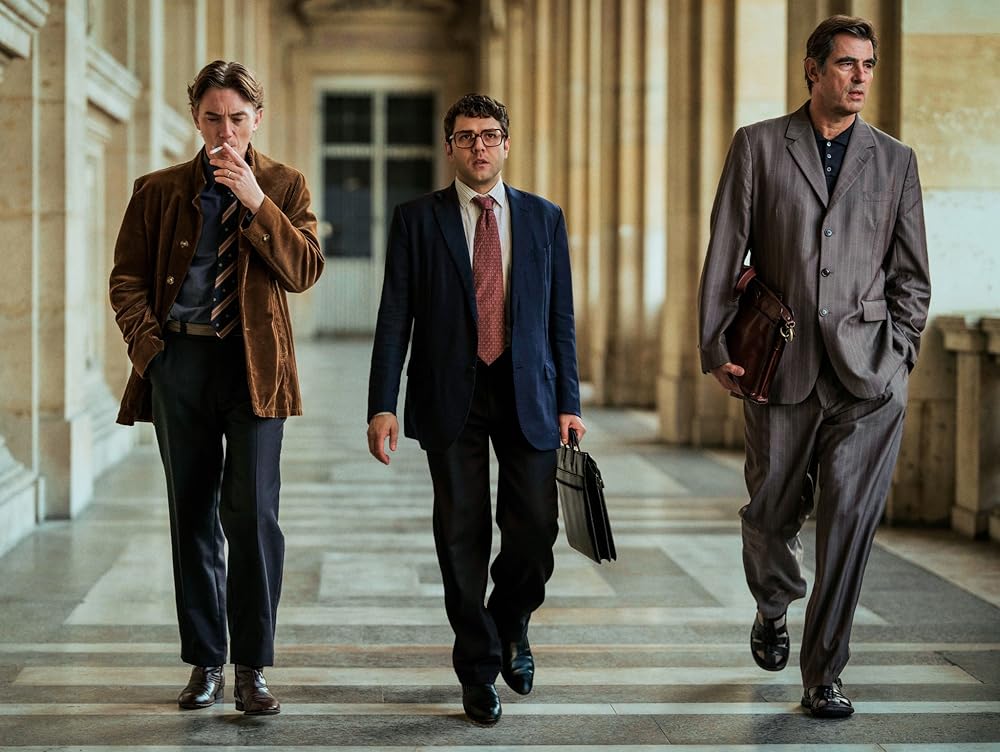
Dir. Stéphane Demoustier | Un Certain Regard – Cannes2025
In L’Inconnu de la Grande Arche, Stéphane Demoustier turns his camera to the skies—both literally and metaphorically—offering a gripping and at times darkly comic portrait of one man’s impossible dream against the machinery of state. After Borgo, which plunged into the intimate violence of a Corsican prison drama, Demoustier ascends to the grand narrative of national identity, architecture, and power.
At the heart of the film lies the enigmatic figure of Johan Otto von Spreckelsen, a Danish architect so obscure that even the Danish embassy struggles to identify him when he unexpectedly wins the prestigious design competition for the Grande Arche de La Défense—an anonymous contest launched by President François Mitterrand to crown his Grands Projets. Played with quiet intensity and flashes of stubborn passion by Claes Bang, Spreckelsen is not your typical starchitect. He has no firm, no team, no reputation beyond four modest churches and his own home. And yet, he is chosen to construct a new symbol of France.
The film opens with a moment of bureaucratic farce—the president’s advisors scrambling in disbelief over the identity of this unknown winner. It’s a wry nod to the absurdities of statecraft and a subtle foreshadowing of the chaos to come. For Spreckelsen, the Grande Arche is not just a building—it is an expression of geometry, purity, and conviction. A sacred cube (nearly), carved into the sky. He refuses to compromise, whether in design or material, even if it means using a construction material three times more expensive than the standard.
Demoustier captures the unfolding drama not just as an architectural saga, but as a battle of ideals. Spreckelsen is a Don Quixote of concrete and steel, charging into a world of political tides, budgetary pressures, and elite rivalries. As the political landscape shifts—most notably with the 1986 legislative victory of the right and the onset of France’s first cohabitation—the wind tilts harder against him.
The brilliance of the film lies in how it stages architecture not as backdrop but as drama itself. The Grande Arche becomes a battleground of meaning: between the immaterial idea and the material constraints, between an artist’s vision and the machinery of a nation. Echoing Rem Koolhaas’s famous quip—that architects believe they are gods but possess no real power—the film underscores the existential paradox of the profession.
Visually restrained yet elegant, with a production design that subtly evokes the tension between brutalist ambition and administrative blandness, L’Inconnu de la Grande Arche is less about the triumph of form than the tragedy of vision. The pacing is sharp, the tone oscillating between ironic detachment and deep empathy.
By the end, what remains is not just a monument in the Parisian skyline but the lonely figure of a man who refused to yield. Spreckelsen emerges as a tragic hero—unwilling to bend, unable to thrive in the world that celebrated and then crushed him.
Do
Demoustier delivers a deeply intelligent and moving reflection on art, power, and the price of fidelity to one’s ideals. L’Inconnu de la Grande Arche is a film that elevates biography into allegory—a meditation on creation in the shadow of compromise.