



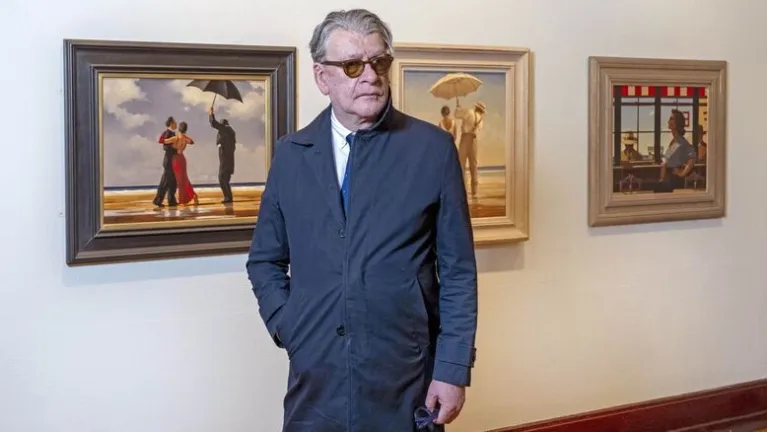
The Singing Butler, Jack Vettriano’s most famous painting, feels more like a dream than reality: a vision of two lovers dancing in formal attire on a misty beach where time seems to have stood still. The woman wears an evening gown, the man exudes dignity, and a loyal butler with an open umbrella appears to be the guardian of this moment’s silence and reverie. Everything in the image carries a nostalgic and poetic tone—a wordless, unhurried dance amid wind and rain. The painting has the aura of a classic film, as though a lost romantic moment from cinema has quietly settled onto canvas.

Despite critical scorn—his paintings once compared to “sweets wrapped in greasy paper,” something pleasurable yet devoid of artistic merit—this particular work took another path. It bypassed the halls of galleries and went straight into people’s homes and hearts, becoming one of the most beloved and best-selling art prints in Britain. Not because of its technique, but for the feeling it leaves behind—a yearning for something we may never have had, but have always been searching for.
The art establishment continues to disdain him, claiming that he “doesn’t paint, he merely applies paint.” But ordinary people have fallen in love with his work. Vettriano exists outside traditional artistic frameworks—something that makes critics uneasy, even seeing him as a kind of transgressor. Because, quite simply, he is popular.

His paintings are neither classical, nor cerebral, nor conceptual. They are full of bold, exaggerated colors, commercial in style, evoking past decades, often carrying a misogynistic gaze. In works like Submission, women are portrayed in states of surrender and subjugation. Vettriano depicts people dancing on beaches in 1930s attire—gangsters and strong men in tailored suits, women in simple lingerie. His paintings resemble scenes commissioned by those immersed in a world of luxury and excess—men with shirts unbuttoned too far, in slick, sensual settings where pleasure and desire reign.
Unapologetic simplicity and emotional directness—free from shame or explanation—are the essence of Vettriano’s allure. He sold thousands of prints to everyday people because, within his frames, nostalgia, longing, passion, and love flowed unfiltered. When you look at one of his paintings, you understand it instinctively, without needing to analyze—it feels as if a familiar soul whispers to you from within the canvas.

For instance, Dance Me to the End of Love, named after Leonard Cohen’s famous song, shows a couple embracing in dance, in an intimate and secluded setting where time appears suspended, allowing only love to move freely. Like many of Vettriano’s works, it radiates a gentle warmth, a sweet melancholy, and a lyrical sense of longing. It is a silent romance that has captured many hearts and adorns countless walls in homes across the world.
The problem with much of contemporary art is that it demands to be understood—not with the heart, but with the intellect. And that creates distance. But Vettriano neither creates nor accepts distance; he pulls you directly into his world without preamble. With the quiet tenderness of his paintings, he liberated art from the exclusivity of elites and placed it in the embrace of ordinary hearts—a transgression that many in the art world see as unforgivable.
But is the human heart not vast enough? One can weep in solitude with Schubert and still dance impulsively to Boney M. If art is honest, then it belongs to everyone.