



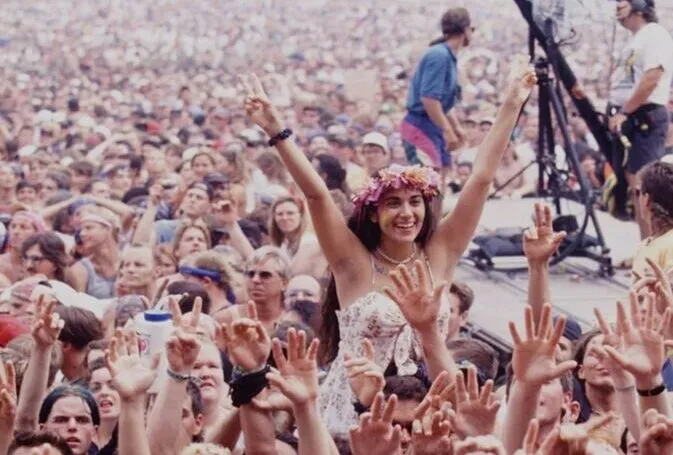
Woodstock, often known as the “Three Days of Peace and Music,” was one of the most prominent cultural events of the 20th century, held from August 15 to 18, 1969, in Bethel, New York. This event went beyond being merely a music festival and became a defining moment for the counterculture generation. Woodstock symbolized unity, protest, and a longing for a better world in an era filled with turmoil and social changes. The festival, with nearly half a million attendees—far beyond the organizers’ expectations—became a historical milestone. The event featured some of the most prominent musicians of the time, such as Jimi Hendrix, Janis Joplin, The Who, and Joan Baez. Their performances, infused with messages of peace, love, and opposition to the Vietnam War, became some of the most enduring moments in music history. Woodstock was not just a music festival, but could be viewed as a philosophical and cultural turning point—an event that served as a physical and spiritual gathering, reflecting the collective discontent and aspirations of a generation. For nearly half a million participants, Woodstock was a moment of transcendence; a place where ideals of peace, unity, and resistance to unjust social structures intertwined. However, to fully understand this event, it is necessary to examine its philosophical roots, mythological perspectives, and its connection to larger global movements.
Woodstock was initially designed by four managers and producers—Michael Lang, Artie Kornfeld, Joel Rosenman, and John Roberts—as a profitable venture to fund a recording studio in New York. But, as Lang recounts in his book The Road to Woodstock:
“We weren’t just creating a festival; we were building a space where people could come together and live the ideals of freedom, peace, and love that we believed in.”
These ideals emerged in the early 1960s, a decade marked by the Vietnam War, the Civil Rights Movement, and the rise of counterculture that sought to challenge the norms of a consumerist and conformist society. Music became a powerful art form and voice of these protests, with Woodstock serving as a global stage for this movement. Woodstock was a symbol of the counterculture, showcasing ideals such as peace, opposition to materialism, and collective responsibility.
The event was initially planned as an official ticketed event, but as the number of participants swelled and barriers broke down, it quickly transformed into a free gathering. Michael Lang, one of the organizers, reflects on the initial expectations: “We anticipated about fifty thousand people, but when the number of participants reached into the hundreds of thousands, it far exceeded expectations. At the same time, in the midst of that chaos, there was something magical—people created a new community for three days.”
Max Yasgur, the landowner of the festival site, said: “At first, I didn’t think about the number of people. But when I saw this huge crowd of young people, I realized we were witnessing a historical moment. They didn’t come to rebel; they were here to celebrate something bigger than themselves.”
The start of the festival was beyond expectation. Even the performers themselves did not anticipate the massive crowd. Richie Havens, who kicked off the event with his performance, said: “When I went on stage, I didn’t know I had to play for three hours. I kept improvising because people kept coming. The energy of the crowd was something I had never experienced before—it was unity. I felt like I was leading something bigger than myself. It wasn’t just me singing, we were all speaking together through music.”
The goals of Woodstock went beyond mere entertainment. The event acted as a free platform for protesting the Vietnam War, critiquing capitalist consumerism, and experiencing alternative lifestyles. The performances also carried political undertones; Joan Baez dedicated her songs to the resistance forces, while Joe McDonald’s iconic song “I-Feel-Like-I’m-Fixin’-to-Die Rag” directly challenged the war.
The festival was not without its difficulties. Its lack of preparation reflected the chaotic energy of the times. However, it was precisely this chaos that made it a moment of solidarity. Water and food were scarce, the weather was uncooperative, but people shared whatever they had—this was a symbol of the collective ethics that defined the counterculture. The rain poured, mud was everywhere, yet no one lost their composure. People shared food, blankets, and water with each other. It felt like a utopia, even if only for one weekend.
Some newspapers described the event as “an unorganized mess,” criticizing its lack of planning. However, most participants and organizers rejected these claims and emphasized its success as a spontaneous and peaceful movement.

Philosophical Links: Woodstock Through the Lens of Heidegger
From the perspective of Martin Heidegger’s philosophy, Woodstock becomes a profound phenomenon in the search for authenticity in a world that has become alienated and fragmented.
The 1960s were marked by unrest and deep social crises. The Cold War had a dominant role in many aspects of life, with two nuclear superpowers in constant competition. The constant fear of annihilation, the systemic alienation caused by rapid industrialization, and political frustrations had a profound effect on the youth of the time. This generation faced a world where existence itself could be destroyed with the press of a button.
Heidegger’s concept of “being-toward-death” provides a fitting framework for understanding this alienation. This idea suggests that awareness of mortality forces individuals to confront the meaningless of a pre-determined life imposed by societal norms. According to Heidegger, this confrontation creates the possibility for authentic existence—life where individuals courageously accept ownership of their being. The Cold War, with its constant reminders of death, transformed this existential insight into a collective self-awareness for the 1960s generation.
Philosopher Alexander Griffith’s analysis of Woodstock presents the event as a direct and meaningful response to the existential despair and confusion of the times. Griffith believes that “Woodstock was not an escape from reality, but a direct confrontation with it.” Against the backdrop of wars, materialistic culture, and systemic alienation, Woodstock created an alternative space for people to engage in authentic human connections.
At Woodstock, solidarity, cooperation, and sincerity emerged—values that Heidegger associates with authentic existence. Participants rejected the prevailing norms of society and instead immersed themselves in a collective experience that allowed for real human connections. Music, as a universal language, became the medium that bridged these authentic connections. Heidegger believed that inauthentic life is one where individuals blindly follow external pressures, living a constructed life—what he called “das man” (they-being)—shaped by social conventions, institutions, and unexamined rules. Authenticity, on the other hand, requires liberation from these constraints and the courage to express individuality. Woodstock clearly showcased this dynamic. The festival’s slogan, “No Rules,” was a symbol of widespread rebellion against pre-established societal norms. Rejection of rigid structures—whether political institutions or social conventions—was a direct manifestation of what Heidegger referred to as the quest for authenticity. Participants at Woodstock sought to discard artificial identities and rediscover their shared humanity.
This was evident not only in the behavior of the attendees but also in the performances of the artists. Musicians like Jimi Hendrix and Janis Joplin brought an unfiltered, raw emotion to the stage that aligned with the audience’s longing for truth. Collective actions like sharing food, helping strangers, and standing together in difficult weather conditions reflected Heidegger’s ideas about authentic collective existence—where individuals engage in collective efforts while maintaining their independence.

The May ’68 Unity: A Global Movement
At the very moment that Woodstock unfolded on the muddy fields of upstate New York, it is undeniable that this event mirrored the political and cultural equality that aligned with the wave of global protests, including the May 1968 demonstrations in France. Both—May ’68 and Woodstock—united in their critique of structures of domination and their affirmation of collective action. In May ’68, workers and students united to challenge capitalist structures and state power, occupying factories and universities, creating temporary spaces full of companionship and solidarity. Likewise, Woodstock became a physical manifestation of these revolutionary ideas, except this time, rather than barricades and strikes, it was expressed through art and music.
Both movements seriously opposed consumerism. The famous May ’68 slogan, “Sous les pavés, la plage” (“Under the paving stones, the beach”) referenced this theme, symbolizing a desire to uncover a truth hidden beneath the superficial layers of modern life. Similarly, at Woodstock, this sentiment was reflected in the rejection of material wealth and the embrace of communal living.
In the fleeting utopia of Woodstock, just like the barricades of May ’68, the seeds of a new world were sown. These movements remind us that the search for authenticity, equality, and unity is both timeless and global—a message as relevant today as it was on the muddy grounds of Bethel or the cobbled streets of Paris.

Cultural Artifact or an Archetype
Woodstock has become a cultural myth deeply embedded in American history, symbolizing the ideals and contradictions of the 1960s counterculture movement. Scholars such as Mircea Eliade, Charles Breiden, and Robert C. Roland have proposed theoretical frameworks that show how historical events like Woodstock can transform into enduring myths. These thinkers believe that myths are not just narratives but cultural constructs that transcend time and present archetypes of values and social identity to communities.
Eliade views myths as sacred stories rooted in symbolic and timeless realms. These narratives provide meaning and existential interpretation, reinforcing and solidifying social norms. Breiden regards myths as rhetorical tools that can amplify collective emotions and attitudes, gaining more power through repetition and romanticized retellings. Roland defines myths as archetypal constructs relying on heroic figures and transformative narratives to establish a deep connection with the culture of society. These theoretical frameworks collectively show how Woodstock, with its themes of peace, freedom, and collective convergence, aligns with the archetype of a cultural myth.
Woodstock’s legacy has been preserved through its continuous presence in the media, from famous films and musical works to references in contemporary culture. These representations have solidified Woodstock as a mythic event, offering an idealized image of unity and idealism, despite the operational challenges and difficulties it faced. This enduring myth reflects the counterculture movement’s desire for social change and demonstrates how collective memory and narratives can transform historical events into prominent symbols.
In conclusion, Woodstock proves how large gatherings can shape identity and strengthen communities. Today’s large-scale events, from music festivals to protests and social movements, follow the same psychological principles. They bring people together in solidarity, provide them with a sense of purpose, and leave lasting emotional impacts. At the same time, organizers must be aware of the possibility of chaos, groupthink, or harmful group behaviors.
Gatherings like Woodstock have enormous effects because they remind us of the significance of belonging, sharing, and collective stand. This sense of togetherness—human connection that transcends differences—is vital for individual well-being and the advancement of society.
