



Art as a Means of Reviving the Ruins of Conscious Life in Lost or Buried Sections
In many art history books, it is stated that art can be the result of destructive and aggressive instincts. However, in a more moderate view, it is considered a conscious reaction of the artist in relation to reality. It must be kept in mind that making the right decision in this matter is influenced by the history and discourse in which the artist has lived and thought.
For example, if we think about the first paintings of humans on cave walls, depicting animals and the act of killing and hunting, it was the result of those humans’ desire to possess creatures and declare their dominance over the world. On the other hand, in a world dominated by Christian and Jewish beliefs, all events of the world are determined by a just God. Every tragedy leads to resurrection and every disaster ends in good. So, for an artist who holds such a belief, depicting a scene of crime and slaughter can have a historical reporting or moral judgment aspect.
However, in modern art, we see a kind of rejection and alienation, similar to what is left by the paintings of the 16th century. Julia Kristeva aptly formulates the creation of such art as the crisis of contemporary life, showcasing the violence that humanity and its fate have targeted. According to Kristeva, something that disrupts the order of a system is what is rejected or objectified. For example, a corpse. Our encounter with objects as the other is, in fact, an encounter with the rejected stranger within ourselves, and consequently, it signifies our emergence from a world like the mother’s womb, where by accepting the other and rejecting the self, our subjectivity is formed. This view of Kristeva, influenced by Bakhtin’s grotesque bodies, led to the creation of bodies that deviated from their ideal form. Bakhtin describes grotesque bodies as contrasting with transcendental bodies. A body that aims to undermine hierarchies and norms by alienating and deforming, showing its baseness to amplify its objectification and repulsiveness. With this perspective, everything that has been denied and destroyed by history or culture can be attacked. Generally, the grotesque spirit that has manifested at various times has been a response to social and environmental conditions.
In this regard, the Baroque era artworks reflect themes of transformation in literature and art, serving as mirrors to the aesthetics of revenge and violence. In Baroque works, gender and corporeality are emphasized. Their surfaces and qualities, the wrinkles, and disintegration of the painted body go beyond mere realistic depictions of flesh and blood, revealing the body as it is, with its corruptibility and deformity. In this way, it creates a new perception in the viewer’s experience. Although many historical motivations can be listed for the emergence of the Baroque style, the Baroque artist, through chiaroscuro and placing figures in dramatic situations, strives to engage the emotions of the audience with fidelity to reality.
For example, the use of colors and textures that do not quite align with reality make a greater impact. The impasto technique, for instance, involves applying thick layers of material to the canvas, causing the image to detach from the surface and create a tangible representation of the texture and weight of the body.
But what does modern affect mean? For Deleuze and Guattari, affect is something impersonal, singular, and capable of connecting with other affects in a singular way. It leads to a shift from one experiential level of the body to another, signifying an increase or decrease in the capacity of that body to act. Affects are independent of their subjects and are created by artists, producing blocks in space and time that lead to the transformative power of art. This transformation displaces an element from its original place to create something new. Thus, art is the creation of movement, not representation.
All the measures taken by the Baroque artist show how they sought to generate new emotions and create a new perception in new worlds. By showing extreme ruptures and disintegration, they aim for an exploration of art. Extreme here refers to an invading and transformative force that invalidates certain norms.
The main factors for displaying violence in artistic works are: 1) time out of joint, 2) fragmented surfaces, and 3) transgression of the established boundaries of representation. In her book “The Matter of Violence in Baroque Painting,” Bajan Kornia excellently addresses the role of art in genesis and transformation. She believes that paintings have the capacity to bring about such transformations by displaying extreme violence.
She begins her reinterpretation of paintings by referencing two important concepts. The first is borrowed from Roland Barthes. In Camera Lucida, Barthes considers the attraction of photographs to result from the interplay of two elements. The studium is the domain that affects the viewer through their awareness and culture, while the punctum disrupts the former. Instead of me approaching a work based on my awareness, it is the work that aims something like an arrow at me. These works wound my body.
The second concept is borrowed from Marcel Proust’s In Search of Lost Time, where for the character Bergotte, a moment before his death, in front of the painting View of Delft by Johannes Vermeer, an image is created that he calls pan. This moment disrupts the continuity of the system of image representation. Bergotte sees a yellowish patch in the painting and repeatedly utters the phrase “petit pan de mur jaune” — a small piece of yellow wall. This encounter seems so destructive that it seems that Bergotte dies in front of the painting because of it.
These two concepts form what creates an unavoidable and soul-crushing touch for the audience.
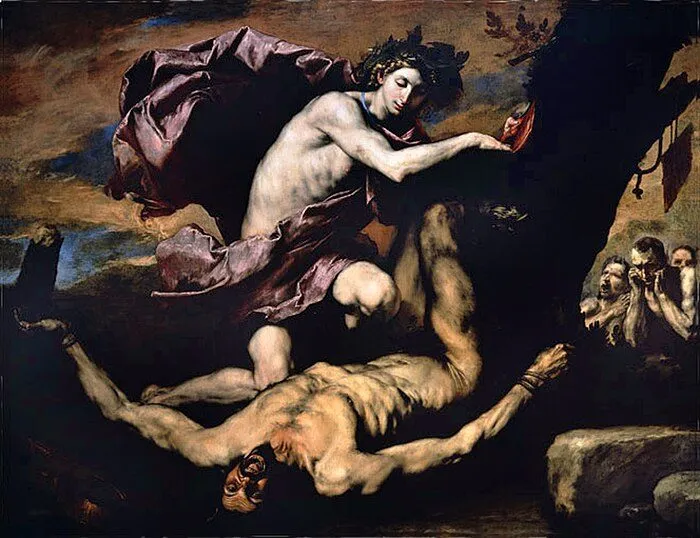
In many paintings from this period depicting violence, there is often a scene of skin being peeled away. For example, consider the famous work Apollo and Marsyas by Jusepe de Ribera. In this painting, Apollo’s figure stands impassively, peeling Marsyas’ skin from his living flesh. Marsyas’ face, with his body contorted and pouring out, gazes at us in horror with an open mouth, silently screaming, while three other faces, horrified, observe the event. But here, at the point where the edge of Apollo’s cloak nears the open, wet wound of Marsyas, an interesting contrast emerges.
The cloak, resembling a skin separated from the body, seems to hint at the continuation of the story. The true horror for us comes when we know that the skin will be peeled away from the body, exposing the muscles beneath. This is the pan of the image. The cloak is freed from its nature, evoking the opening of the wound.
In the painting Saint Ursula by Caravaggio, an arrow strikes the woman’s body, but she casually looks at the wound. Blood is expected to pour from this wound, but the woman remains indifferent, perhaps with a touch of curiosity. Her eyes are wide with astonishment. She stands with a pale body, as if her soul has left her, and the materiality of her body slowly changes. Everything in this piece revolves around the concealed wound. A wound that disrupts the body’s integrity and fixes our gaze. A moment of dense ambiguity. Displaying the wound means showing the imminent moment of collapse. Thus, the body of Ursula transforms. She witnesses her own wound, and we become witnesses to her, and in this way, she becomes an icon.
The trace of violence in art always reveals a critical view of a hidden reality. In these works, violence seems to be a response to the superficial view of the era and an attempt to break the usual iconographies, the continuity of time, and alter identities. What sets these paintings apart from those of earlier periods is the visual nature that is provided by texture, color, and material richness. When the material separates from its experiential presence and the pictorial surfaces exceed their creation process, they potentially carry new impacts and meanings. In Caravaggio’s works, for instance, the sharp contrast of light, or the way he depicts the sanctification of the body by transforming the body of Saint Ursula, or as we discussed with Ribera’s painting, when the canvas becomes a representation of flesh and blood.


[i] Abject
[ii] Kristeva, J. (2024). Powers of horror: An essay on abjection. Columbia University Press.
[iii] HAAG, I. (1997). The Modern Grotesque—the Mystery of Body and Language. ми, 40.
[iv] Impasto
[v] Ambrose, D. (2009). Deleuze, Philosophy and the Materiality of Painting. 2009). Gilles Deleuze. The Intensive Reduction, London and New York, Continuum, 101-122.
[vi] Cornea, B. (2022). The Matter of Violence in Baroque Painting.
[vii] Studium/Punctum
[viii] Barthes R. Camera Lucida. New York: Hill and Wang Press;1981