



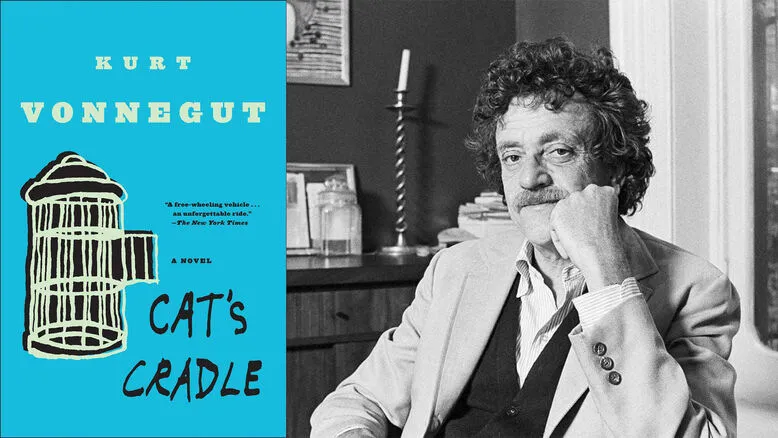
Vonnegut’s prose, like many postmodern works, is filled with wordplay, poeticism, double entendres, metaphors, and puns, elements that are incredibly difficult, if not impossible, to fully translate into any other language.
Kurt Vonnegut is one of the most famous and best writers in American and world literature, although he has not received the attention he deserves in Iran. His most well-known work, which is also the most recognized in Iran, is the novel Slaughterhouse-Five. However, as Harold Bloom points out, the author’s fourth novel, Cat’s Cradle, is in many ways a more important work. But what might be the reason why Iranian readers pay less attention to Vonnegut’s works? One reason, undoubtedly, is the difficulty of translating Vonnegut’s works into Persian. Vonnegut’s writing, like many postmodern works, is filled with wordplay, poetic elements, double meanings, metaphors, and puns. These elements are extremely hard, if not impossible, to fully translate into another language. This issue has made Vonnegut one of the “most poorly translated” Western authors in Iran. Another reason for the lack of attention could be the limited familiarity or lack of familiarity of Iranian readers with postmodern literature. Apart from these reasons, political and cultural factors can also be mentioned. For example, relativism and the lack of certainty inherent in this type of novel, as well as its often non-Aristotelian, fragmented structure, may seem unfamiliar to people in ideologically-driven countries. This kind of audience has not received any education about this type of novel writing in schools or even in universities, so naturally, they struggle to connect with postmodern novels. A brief look around bookstores in Iran and an analysis of the statistics of books that are printed more often show that Iranian readers tend to favor realist novels like those by Ahmad Mahmoud, Mahmoud Dowlatabadi, Balzac, Dostoevsky, Dickens, Tolstoy, and other realist writers. In this brief piece, I will take a look at Kurt Vonnegut’s postmodern novel Cat’s Cradle.
Plot of the Novel
Cat’s Cradle is a science-fiction, satirical, and anti-war novel that also deals with themes of science and religion throughout its narrative. The story’s narrator, Jonah, is writing a book about the day the atomic bomb was dropped on Hiroshima. To complete his book, he investigates one of the scientists involved in creating the weapon, Dr. Felix Hoenikker, and corresponds with his children, or visits his workplace in Ilium, gathering information through interviews. During these investigations, the narrator discovers that before his death, Hoenikker invented a dangerous substance called Ice-Nine. Ice-Nine is a substance that can freeze all the water on Earth, thus causing the complete destruction of all life. The narrator also finds out that after Dr. Hoenikker’s death, Ice-Nine was divided between his three children: Frank Hoenikker, a man who lives on the fictional island of San Lorenzo and holds an influential general’s position there; Angela Hoenikker, a strong woman who served as her father’s nurse; and Newt Hoenikker, a dwarf who is passionate about painting. The narrator continues his research by traveling to San Lorenzo, a place ruled by a dictator named Moon-Of-Albion, where the people secretly follow a forbidden religion called Bokononism—an ideology filled with contradictions, nihilism, and dark humor. Amid these events, Moon-Of-Albion, who had swallowed Ice-Nine before his death, freezes to death, and through a series of events, this substance reaches the oceans and leads to the freezing of all the water on Earth, resulting in the destruction of life.

Analysis of the NovelCat’s Cradle
As the summary of the novel suggests, we are dealing with popular literature in the science-fiction genre. This mixture with popular culture and the closeness to popular literature is precisely one of the most important differences between this type of novel and the modernist novels that preceded it (for example, compare it with As I Lay Dying by Faulkner, Ulysses by Joyce, and Mrs. Dalloway by Virginia Woolf, whose audience was predominantly educated and, in a sense, cultured individuals). But what concepts lie behind this story? This is where we need to briefly touch on the theories of one of the most famous postmodern philosophers: Jean-François Lyotard.
Jean-François Lyotard, according to his beliefs and theories, considers postmodernism synonymous with mistrust in grand narratives. He states, “A grand narrative, regardless of the unifying method it uses, whether it is theoretical or emancipatory, has lost its credibility.”
For instance, the grand narrative of “scientific belief and progress” that emerged during the Enlightenment believed that faith in science and its pursuit, alongside the rejection of anything unscientific, would pave the way for human progress and guarantee an easy and prosperous life. Absolute belief in this grand narrative led thinkers and the general public to overlook other aspects of life. One cannot deny that scientific progress has brought many benefits to humanity, but it must also be accepted that blind faith in this grand narrative has, at the same time, been destructive. The atomic bomb, weapons of mass destruction, the pseudo-scientific works of the Nazis, and so on, are all the results of absolute belief in the redemptive narrative of “scientific belief and progress.”
Cat’s Cradle
What Kurt Vonnegut does in Cat’s Cradle is precisely to show the decay of two grand narratives: the narrative of scientific belief rooted in Enlightenment philosophy and the narrative of religious faith. The former can be seen in the theories and actions of the character Dr. Hoenikker, the fictional father of the atomic bomb in the novel. Repeatedly in the novel, we encounter statements about “the redemptive power of science,” statements that are accompanied by a kind of irony, often spoken by characters who are portrayed as ignorant and foolish. In contrast to this belief in the redemptive power of science, the novel also introduces a fictional and fraudulent religion called Bokononism, which has its own prophet, Bokonon. However, neither of these two grand narratives saves humanity.
On one hand, the clash between science and religion in this novel can lead us to the classical philosophical opposition between “logos” and “mythos.” These two concepts, with a little leniency, refer to “logical reason” and “mythical thinking,” respectively. Religion (mythos) is represented in the novel through Bokononism, a religion that is consciously based on lies (in the novel: foma). In the Book of Bokonon, which is the fictional holy book of the false prophet in the novel, we read:
“Live with foma, which makes you brave, kind, healthy, and happy. Book of Bokonon, 1:5”
Later in the novel, it is explained that foma refers to “harmless lies.”
Even though the prophet of Bokononism directly states that his religion and its myths are fake and constructed, his followers continue to believe in him secretly, even at the risk of their lives. This shows that humans, in their search for meaning in their meaningless lives, always need mythical narratives, and they cannot tolerate living without them.
On the other hand, in the novel, science (logos) is not only not redemptive for humanity, but it is also catastrophic. Initially, it creates the atomic bomb, and ultimately, the fictional substance Ice-Nine, which freezes all life. Science in this novel is devoid of any morality. The scientists, without considering the painful consequences of their work, are only interested in discovering and creating new things. Dr. Hoenikker’s character is portrayed like a child who treats his inventions like toys and feels no responsibility for them. His cold and emotionless behavior toward his family also reflects this. For instance, after his wife’s death, Dr. Hoenikker essentially turns his daughter into his nurse, viewing her entirely as an instrument. Vonnegut’s criticism of the redemptive power of science is reminiscent of the writings of Adorno and Horkheimer in Dialectic of Enlightenment. In the first chapter of this book, they ironically refer to the atomic bomb as the “brilliant catastrophe”:
“Enlightenment, in the broadest sense of the word, has always tried to free people from the bonds of fear and establish their dominion and mastery. However, the world, which is now fully illuminated, glows with the brilliant light of catastrophe. The program of enlightenment was to dispel the world’s enchantment, dissolve myths, and overturn fantasy through knowledge.”
In Cat’s Cradle, Vonnegut, with a worldview tinged with nihilism, demonstrates that all of humanity’s efforts to give life meaning and salvation, whether through logos or mythos, will ultimately be in vain.