



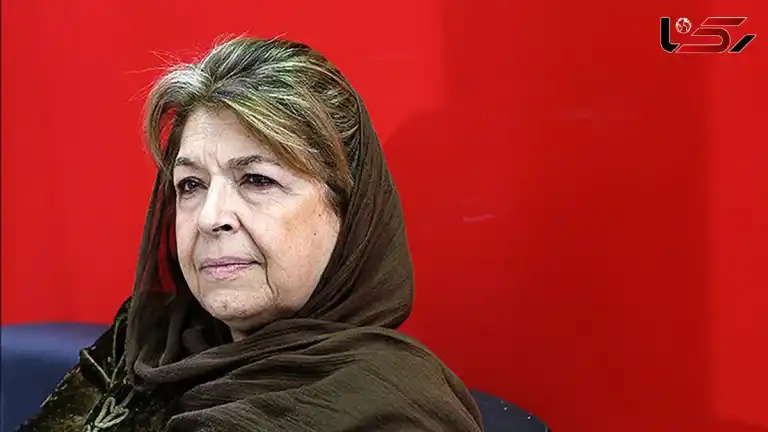
Lili Golestan, translator and gallery owner, needs no introduction. With over forty translations in various fields – from novels to interviews – she is one of the most recognized and prominent figures in the field of literary translation in Iran. In this interview, Ms. Golestan patiently and kindly answered all of my questions.
You are the daughter of a highly renowned literary and cinematic figure. What has it meant to you to be the daughter of Ebrahim Golestan, both in the past and now?
Being Ebrahim Golestan’s daughter has had both advantages and disadvantages. The advantage was that I grew up in a home full of culture and art, and I tried to make the most of this opportunity, and I truly appreciated it. When you wake up to Vivaldi’s Four Seasons in the morning, your father reads you a story he wrote the night before over breakfast, and all your family acquaintances are from the world of culture and the arts, well, that means you’ve been blessed. So you take the opportunity, learn, and remember. I learned, I remembered, and later put it to use and benefited from it.
But the downside, which still exists, is that whenever I achieved something, people would say, “If our father was someone like that, we would’ve done the same, you didn’t do anything yourself!” Even when my first book was published (Nothing, and So Be It by Oriana Fallaci), they said my father had translated it for me so his daughter would become famous! Sadly, that sick mentality still persists. But from the beginning, I learned to let it go in one ear and out the other! Still, I feel sorry for people who think that way. They haven’t accomplished anything in life to be proud of, so they’re bitter and resentful individuals who get upset by others’ success. It’s unfortunate – for them.

Why do you think jealousy and resentment are so common among people in Iran’s literary and cultural circles? Why can’t they celebrate one another’s successes? Or maybe this trait isn’t specific to Iranians or even to cultural types.
Jealousy and narrow-mindedness are rampant in Iran. I honestly don’t understand this attitude. Many times, I’ve read a well-translated book and gone out of my way to find the translator’s phone number just to call and congratulate them – much to their surprise! I get genuinely happy about any successful work and express my joy, which often surprises people! It’s really both ridiculous and sad. I’ve rarely seen someone who is truly happy about others’ success or happiness. I just don’t understand it at all.
One of your most beautiful remarks in an interview was: “Enjoy your life, which is a gift from God, and strive to make it better.” What do you usually do to maintain or improve your quality of life in line with that philosophy?
I live. Out of habit, I go to the cinema, I go to the theater, I attend concerts, and I read books. I also cook! After thirty-five years of continuous, daily work, I closed my gallery, and for now, I only hold exhibitions online. I take care of those online exhibitions too. I also continue translating. I don’t do these things specifically to improve my quality of life, but doing them naturally enhances it.
People used to ask me, with three young children, when do you even find time to translate? Now, young people ask me the same question: when do you find the time!? I always find this question both annoying and funny. If you plan properly, you can manage everything. One thing that has always mattered to me is doing something I truly enjoy. When there’s love and no sense of obligation, you tend to do your work well and properly. That satisfaction brings peace of mind, and that’s what makes me thank God every night when I go to bed.
You once mentioned that when you were at the convent school in France, you lost 15 kilograms. During those lonely days and months in a foreign land, what did you do? Did you have an imaginary friend or a real one to ease your pain a little?

I had neither an imaginary friend nor a real one, and out of sheer stubbornness, I didn’t even learn French. I just cried.
You’ve interviewed some writers, like Ahmad Mahmoud. Did you ever want to interview your father? What do you think about the interviews done with Mr. Golestan? About his blunt tone and harsh, unconventional judgments of famous Iranian writers, poets, and filmmakers?
I had a wonderful conversation with the dear Ahmad Mahmoud. Right now, I’m speaking with Mahmoud Dowlatabadi, which will become a book. I never wanted to have a conversation with my father. Every time I tried to talk seriously with him, all I received was humiliation. As for his interviews, he spoke with just anyone, simply because he was not in Iran and didn’t want to be forgotten. But a wise person should be more selective. He always acted like someone apart from everyone else, and I never liked his condescending and arrogant attitude. I always kept my distance. Things were fine between us until I reached adolescence, then it changed.
You once mentioned that during your childhood, your home was frequented by literary and intellectual figures like Akhavan Sales, Parviz Dariush, Beyzaei, Chubak, Al-e-Ahmad, Bijan Elahi, Bahman Mohasses, Pari Saberi, and Samandarian. Can you share one of your fond memories from that time?
Their visits were always delightful. They cared for each other and were open to criticism. They would critique and praise one another’s work. Sometimes there were loud arguments, but in the end, everything would resolve with peace, friendship, and mutual respect. One memory I have is of Akhavan Sales, who had to stay away from his own home for a while and lived with us for about a month. His presence was so warm and pleasant. We would sit on the grass, and he would start reciting poetry. I was in sixth grade, and I enjoyed it so much.
Do such literary and intellectual gatherings still exist in Iran today? For example, does such an atmosphere exist in your own home?
Unfortunately, cultural and artistic people no longer gather like that or have deep friendships. Right after the revolution and for several years after the war, those gatherings were held at my home and were very enjoyable. But later, most of them either left Iran or passed away, and sadly, such gatherings no longer happen.
After the revolution, which figures participated in the gatherings at your home?
Morteza Momayez and his wife Firoozeh, who was a painter. Sirus Tahbaz and his wife Pouran, who was a translator. Mohammad Ehsai, a painter. Ali Hatami, a film director, and his wife Zari Khoshkam, an actress. Abbas Kiarostami, the filmmaker. Bahman Farmanara, the filmmaker, and his wife… These people used to come to my house almost every Friday after the revolution and during the years following the war.
What are your thoughts on the current women’s movement in Iran, especially following recent events and the fight against compulsory hijab?
I’m very hopeful about the new women’s movement. But I know that a long and difficult road lies ahead. We won’t reach our goals easily. We’ve already paid a heavy price, and we will continue to do so, but we won’t remain in darkness. At the end of the tunnel, a bright light can be seen.

How would you define the modern Iranian woman?
A modern woman is someone who stands on her own feet and is not dependent on her husband. She should be able to express her opinions with sound reasoning. She must have independence in both speech and behavior. I have a lot of hope in the new generation.
Cinema has had an important place in your family. Your father was one of Iran’s major filmmakers, your ex-husband, Nemat Haghighi, was a prominent cinematographer, and your brother Kaveh was a well-known photographer. What is your own relationship with cinema like?
My only regret is that my father sold his studio and didn’t want me or Kaveh to continue his work. When I worked at National Iranian Television, I was the head of children’s and youth programming, and I used to edit the films we produced myself, and I fell in love with it. Whenever I see a father bring his children into his profession and continue the work as a family, I find it beautiful. Unfortunately, my father never invited us to work in his studio.
Were you ever interested in acting in films at any point in your life?
No, I never thought about it. I had a small role in my son Mani Haghighi’s film “A Dragon Arrives!” and apparently people said I acted well! Not long ago, I joked with Kimiaei and said, “If you have a role for a mother or grandmother in your next film, give it to me!” We laughed a lot. I really love cinema. I follow the work of young directors and watch two or three films every month. I prefer to see movies in theaters. I drive myself there and go alone.
Is going to the cinema alone a conscious choice for you?
I’ve been living alone for years and I’m completely fine with it. I go to the cinema alone. I go to the theater alone. I visit galleries alone, and I’m comfortable with it.
You’ve translated major literary works, including those by Romain Gary, Gabriel García Márquez, Miguel Ángel Asturias, Albert Camus, and Italo Calvino. How do you choose the books you translate, and what defines a good translation in your view?
There’s only one condition for choosing a book to translate: I have to fall in love with it. Otherwise, I can’t translate it. That’s why I’ve never accepted commissioned translations. A good translator must be faithful to the author’s text and above all, maintain the author’s style. They shouldn’t be verbose or add anything of their own. They should choose the right words – word choice is extremely important. Choosing the right word helps convey the correct style.
In your opinion, what has been the most important impact of your literary translations on Iranian literature?
The impact of my translations should be judged by the readers. In any case, readers got to know authors they hadn’t encountered before. Fortunately, most of the books I’ve translated have been well-received and gone into multiple printings. Just a few days ago, I was told that Camus’s “The Stranger” has reached its 48th printing. That kind of reception motivates me to keep translating. Or “The Little Prince,” which was published eight months ago with illustrations by Noureddin Zarrinkelk, has already reached its fourth printing. That brings me joy, and that’s enough for me.
How much has contemporary Iranian literature—specifically fiction—transformed over the years? How would you compare it to the generation of great writers from the 1960s and 1970s?
Our literature has come a long way, and I follow the works of young writers, but we still haven’t seen the emergence of someone like Ahmad Mahmoud, Mahmoud Dowlatabadi, or Houshang Golshiri from among them. There are two clear differences between our literary landscape now and that of the ’60s and ’70s. First, the absurd and intense censorship; and second, the sheer number of writers. Back then, there were at most thirty writers, now there are three hundred! Of course, censorship existed before as well, but now they censor books wholesale! They might delete thirty pages from a single book! It’s ridiculous.
What’s your opinion on the current state of literary translation in Iran?
Just like in visual arts and other fields, translation today has become superficial. Everyone wants quick results, either to participate in auctions after one exhibition or to become famous with a single book. There’s a rush, and the core principles of the craft are not being respected. Expectations are high, but the quality isn’t. Instagram and other social platforms have done serious damage to the Persian language. The excessive use of foreign words in daily conversations – even in newspapers – is increasing day by day. It’s a mess, and fixing it will take a long time.
Which Iranian writers and translators do you admire?
Among Iranian writers, certainly Ahmad Mahmoud, Mahmoud Dowlatabadi, Golshiri, and Golestan. From the younger generation: Hossein Sanapour, Mahsa Moheb Ali, Sara Salar, Nasim Marashi, and others. As for translators: from the older generation – Mohammad Ghazi, Abdollah Towfigh, Reza Seyed Hosseini; and from the newer generation – Abdollah Kowsari, Mojdeh Daghighi, Mahmoud Hosseinizad, Mehdi Sahabi, and so on.

What are you reading at the moment?
The book “Gholamreza Killed Gholamreza” by Mehdi Mirmohammadi. It’s an extraordinary investigation into the life and death of Gholamreza Takhti, the wrestling champion. In my view, Takhti is used here as a lens to portray the era of the second Pahlavi regime, the authoritarianism of the time, and the toxic relationships within every government institution. It was an excellent book.
Do you have any books currently in press?
No, not at the moment. My last book was The Little Prince, which was published last Esfand (February/March), followed by Thirty-Five Years of Golestan Gallery, as Told by Lili Golestan, which was published two months ago. For now, I’m resting.
If you could have a cup of coffee with any writer, who would it be?
I wish I had known Susan Sontag – I would have had ten cups of coffee with her!!!
If a painter isn’t famous or influential, but you see glimpses of brilliance in their work, would you exhibit them in your gallery?
When I opened my gallery forty years ago, I published a statement in a newspaper saying that the established artists were already known, I would now go in search of young, unknown talents, discover them, and make them known. That’s exactly what I did. And now, I can proudly say that seventy percent of the well-known young painters of today emerged from Golestan Gallery.
Regarding the #MeToo movement, in recent years have young women ever come to you and spoken about the unsafe environment and the abuse of power and influence by public figures? What advice do you usually give them?
I have a lot to say about the “MeToo” movement. We need to understand that most men lack the capacity to handle things properly and are incredibly weak when it comes to their sexual desires. They can’t tolerate ease and openness in a young woman’s behavior and often misinterpret it. It’s rare to find a man who can be friends with a woman without a sexualized view. Worse still is when psychological issues are involved. So girls must always keep some distance when interacting with men and be constantly cautious. It’s difficult, but it’s necessary.
Men have very little tolerance for the ease and casual nature of a young woman and interpret that as something else – as her being “available.” So we must always be vigilant. For example, I had a male friend for thirty years, since I was 22. There was never any sexual connotation in our relationship; we were true companions. But after thirty years, I noticed a change in his behavior, his gaze, and his words. It had become sexualized. Sadly and with much regret, I cut off the relationship entirely. As for the public revelations, yes, some women expose the man’s identity and recount the story in detail in the media to find relief, and this in itself is a form of therapy. It’s a good and necessary action. But unfortunately, the same behavior continues with other men, and the pattern persists. The woman feels better after speaking out, but the man learns nothing, absolutely nothing.
So I believe the only solution is for women to stay alert and keep their distance. Experience has shown me that perhaps only one percent of men do not view you through a sexual lens! It’s strange but true. Unfortunately, we must remain constantly cautious. When I first opened my bookstore, compulsory hijab hadn’t been implemented yet. I was young, with long hair and a cheerful face. I used to engage very openly and warmly with customers. Until one day, a young stranger walked in and asked, “What are you doing tonight?” I threw him out. And from that day on, I became the serious Lili, with an iron shield on my face, and that was that.
Let’s end this interview with love. What does love mean to you?
Without love, life is pure hell.
November 2024